Concealed Carry: Beyond The Law
You got your concealed carry permit or you live in a permissive state that allows you to constitutional carry. Great, what’s next?
Having a firearm and a permit to carry is just the start of your journey and responsibility. When I first started to conceal carry, I too had some doubts. Through training, getting my questions answered and with experience I feel like I have a much better handle of all the facets needed to comfortably and responsibly carry.
Here are some considerations for concealed carry.
1. Legal: Know the law. You need to understand and know when a firearm can be used in a conflict. You can never use it during road rage, to win arguments, or teach someone a “lesson.” You can never be the aggressor. Do you have a duty to retreat or can you stand your-ground? What are places that you can and cannot carry your gun legally? If it gets to the point of actually using your firearm in self-defense or defense of others are you willing to live with the results? Additionally, there are insurance options that will assist with legal expenses from a self-defense incident. A lawyer told me it may cost $10,000 to half a million dollars.
2. Safety: Do you know the 4 Rules of Gun Safety? Not just by memorization, but through the practice of how you handle your firearm. This applies, not only at the range, but every time you handle your firearm. It also includes proper storage. Learn them: live them.
3. Mindset: Have you heard of the Color Codes of Awareness? It is much better to avoid or escape rather than defend. Do you practice the Color Codes of Awareness daily? These were developed to describe your state of mind in how to be defensive; is it not specific tactics. Can you de-escalate a heated situation? Are you willing to swallow your pride and walk away while being insulted, disrespected, spit on or worse?
4. Equipment:
• Guns - If you don’t already have your firearm, do your diligence in finding which firearm YOU can comfortably manipulate, shoot, conceal, and carry. Like cars, make-up, or clothing there is a right fit for everybody. Copying your husband, friend or firearm instructor might not be the best fit for you.
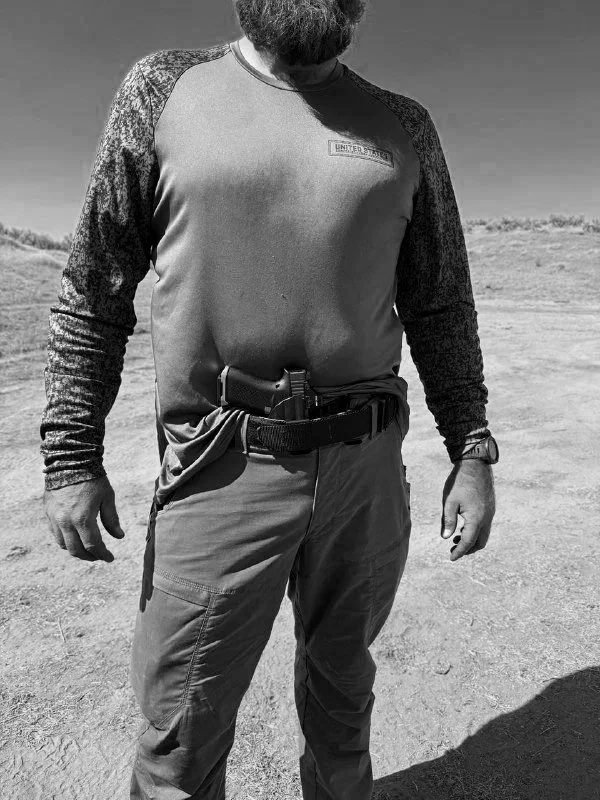
• Holster - It must fully cover and protect the trigger. Maintain it’s shape so you can re holster one handed. Stay in place during the draw. Secure your gun with retention or hide it completely from sight. This might be in the waistband (IWB) or outside the waistband (OWB) or other areas of concealment.
• Gun Belt - It should be stiff enough to hold the weight of the gun and any accessories you may carry. It shouldn’t allow you to lose the gun even if you need to run.
• Concealment garments - Clothing should be loose enough to “hide” the gun to keep it concealed. Depending upon the garment you may carry a little more (bigger gun) or a little less (smaller gun). Also, are you able to live normally, including bending, sitting, reaching, driving without others noticing your firearm.
• Ammo - Using the right ammunition can not only stop the threat faster, but also make your firearm more reliable and decrease the chance of collateral damage. Find appropriate hollow point ammo that works reliably in your firearm.
5. Carry Position of the Gun: There are many ways to carry: IWB, OWB, ankle, or off-body.
• You must be able to draw your firearm efficiently and safely, meaning you don’t muzzle your own body parts.
• The firearm should stay in place and not require you to constantly adjust it. • You should be able to carry it in your chosen method of carry on a daily basis under most conditions. Obviously not during lap swimming, at your child’s school play, or on commercial flights. But, carrying concealed is a decision and one that should not be taken lightly.
• It is generally not comfortable, but should be tolerable. It’ll poke you, weigh on you, cause you to sweat or avoid certain positions.
6. Training:
• Marksmanship - Can you make hits at what you are aiming at: 2-5 yards, 10 yards, 25 yards or more? Know your limits and don’t shoot beyond your limits as you are responsible for every bullet that leaves your muzzle until it comes to a stop.
• Drawing - Be able to draw the firearm from concealment safely and know how to operate it. Does it have a safety you need to defeat? Do you keep a round in the chamber? If not, is it your standard operating procedure to rack the slide when you draw?
• Malfunctions - Do you know the 3 types of pistol malfunctions and do you know how to correct them to get the gun up and running. Work them until they are instinctive. • Dry Fire - This allows you to put in repetition to engrain skilled movements needed in a gun fight and helps make you proficient. Things like drawing, getting the sights quickly on target, proper trigger manipulation, reloads, re-holster, and movement with the firearm can be done in addition to live fire exercises to build your gun skills. Have a routine that removes any live rounds from your dry fire area and never point your firearm at anything you are not willing to destroy. Have a safe backstop for your dry fire practice; just in case. • Tactics - Flat range training is shooting at a range practicing closed skills: draw, reloads, etc. at known targets. These skills don’t take into consideration high cognitive skills during a dynamic critical incident. Working on scenario-based or force-on-force training with live partners, simulated threats, over varied terrain can be invaluable to the realism of an actual encounter and expose weaknesses in your current training.
7. Daily Habits and Routines:
• Consistent storage - Your gun should live on your body, in a locked storage unit or securely staged at home. You should also check the condition of your firearm before wearing it to make sure it’s in the same set up you prefer (round in the chamber, full magazine, etc).
• Minimal handling - Don’t show your gun to others, unholster it, or fidget with the gun in public.
• Treat it like your wallet and car keys: same place, same process.
The moment you get your Concealed Carry Permit and Firearm the real work begins. Get educated, get some quality instruction and put in the practice to become a responsible and competent concealed carry gun owner.
Remember the old adage: When seconds count, police are only minutes away.